When AI Weaves: The Craft-and-Code Fabrics Coming Out of Frankfurt
For readers assessing Italian jacquard fabrics, the practical question is how the idea performs in a real room, not only how it photographs. Heimtextil closed in Frankfurt on 16 January 2026 with 3,000 exhibitors from 148 nations and more than 48,000 buyers. The fair ran under the motto “Lead the Change”, but the sentence doing the most work all week was in Hall 6.1, where the Trend Arena ran under the line “Craft is a verb”, curated by Alcova’s Valentina Ciuffi and Joseph Grima. Trends 26/27 forecasts artificial intelligence and the hand turning up in the same cloth. It is worth separating what the forecast argues from what a loom actually does.
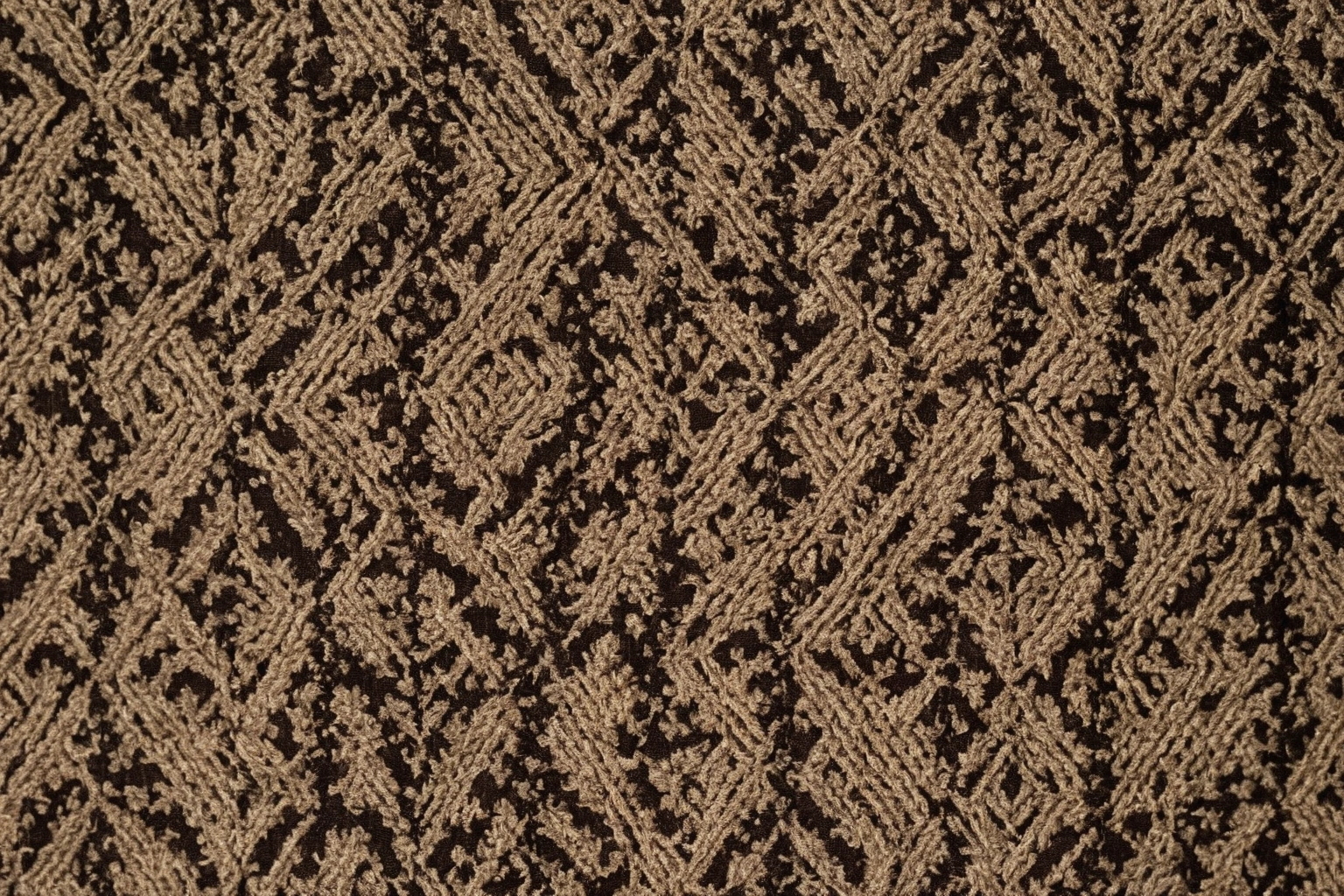
Where the code actually sits
A computer genuinely touches a textile at four points. It leaves the rest alone. The first is design. Generative tools throw off pattern variations faster than a studio can draw them, which makes them a search engine for ideas rather than an author. Heimtextil’s own trend page puts it plainly: artificial intelligence “has long been part of design, precise, efficient, omnipresent”. Design is the operative word. The claim is about the drawing, not the mill.
The other three are older. The loom comes below. Digital printing fires a colour file at cloth with no screens to cut. Inspection puts machine vision on the running frame; a 2014 survey of automated fabric defect inspection named the problem it solves as manual inspection’s “lack of accuracy and high time consumption”.
What none of it does: spin fibre, dress a loom, tie a broken warp end, mix a dye lot to match a client’s memory of a colour, or decide that a cloth feels right in the hand. The Trend Arena is a curatorial argument about where design is heading, not a census of what mills run. Its central figure, the techno-craftsperson, “does not see digital tools as competition, but as an extension of his toolkit”. A related practical reference is available in How Much Furniture a Bedroom Can Take Before Circulation, Storage, and Comfort Break Down.
| Stage | What the machine does | How established | What stays human |
|---|---|---|---|
| Design and pattern | Generates motif variants from a prompt | New, studio-side | Judging which variant is worth weaving |
| Weaving (jacquard) | Reads a stored pattern, lifts each warp thread | Since 1804; cards, tape, then a file | Dressing the loom, yarn, tension, repair |
| Printing | Fires a colour file at cloth, no screens | Predates the AI wave | Colour matching, hand and finish |
| Inspection | Cameras and a classifier flag defects | Researched for decades | Telling a defect from character |
The oldest computer in the room
Joseph Marie Jacquard patented his machine in 1804, building on Basile Bouchon, Jean Baptiste Falcon and Jacques Vaucanson. The Jacquard machine ran on a chain of punched cards laced into a continuous sequence. Each row of holes told the loom which warp threads to lift for one pass of the weft. Change the cards and you change the cloth without touching the machine. That is a stored program, running on silk.
The line into computing is documented rather than folklore. Charles Babbage knew of Jacquard machines and planned to use cards to store programs in his Analytical Engine; he owned one of the woven silk portraits of Jacquard that the looms produced, and it is credited with inspiring his use of perforated cards. Herman Hollerith later pushed punched cards into a tabulating machine that handled the 1890 United States census. Weaving did not acquire computation in 2026. It is part of where computation came from.
The loom was reading a stored program a century and a half before anyone had a word for code. What changed this year is not that weaving became computational. It is that weavers decided to show it.
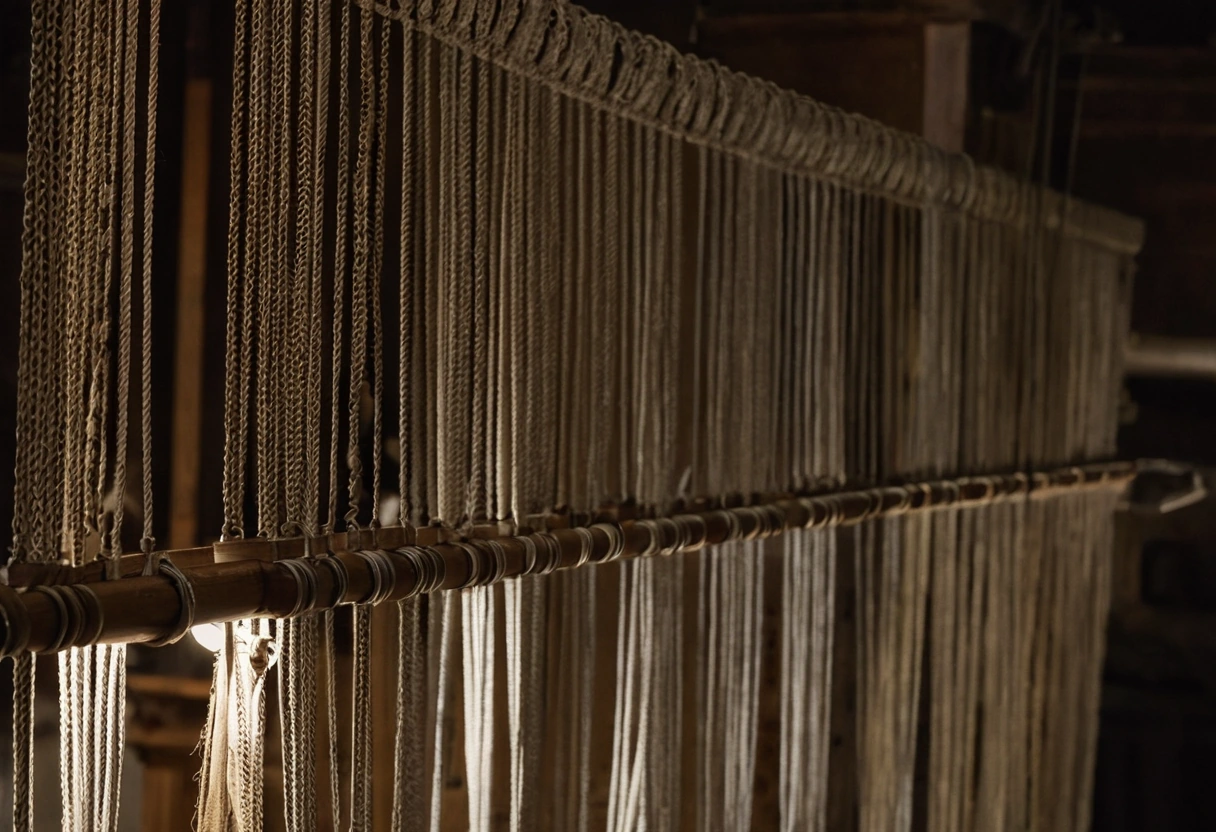
Four streams, read closely
Trends 26/27 names six streams. Two, Sensing Nature and A Playful Touch, are mainly about motif and ornament. The other four put the machine in the foreground. The wider project context is available from preciselypeachy.com.
Re:Media runs a drawing through a loop. A hand sketch becomes a digital rendering, then comes back out as a jacquard or a hand-embroidered pattern. The motifs borrow from glitch: broken forms, pixelated gradients, hand art digitally reworked. The loop matters more than the glitch, because the drawing survives the round trip and picks up the machine’s accent.
Visible Co-Work is the most literal statement of the theme. A design starts in AI, a human designer finishes it, and the join is left showing. The trade press covering the Arena, including Home Textiles Today, reported digitally embroidered linen, 3D knitted patchwork and generative patterns laid over classic cloth. The name is the argument. Further related coverage is collected in Articles.
Crafted Irregularity is the reaction: knots and slubs, uneven dyeing, visible seams, asymmetric finishes, all kept on purpose. Heimtextil frames them as a counterpoint to the flawless perfection of AI-assisted design. Handwoven cloth has always been irregular, and for most of textile history a slub was a fault to pull out. What is new is that irregularity is a stated position rather than a tolerance. The commercial risk follows: a defect and a signature look identical from a metre away.
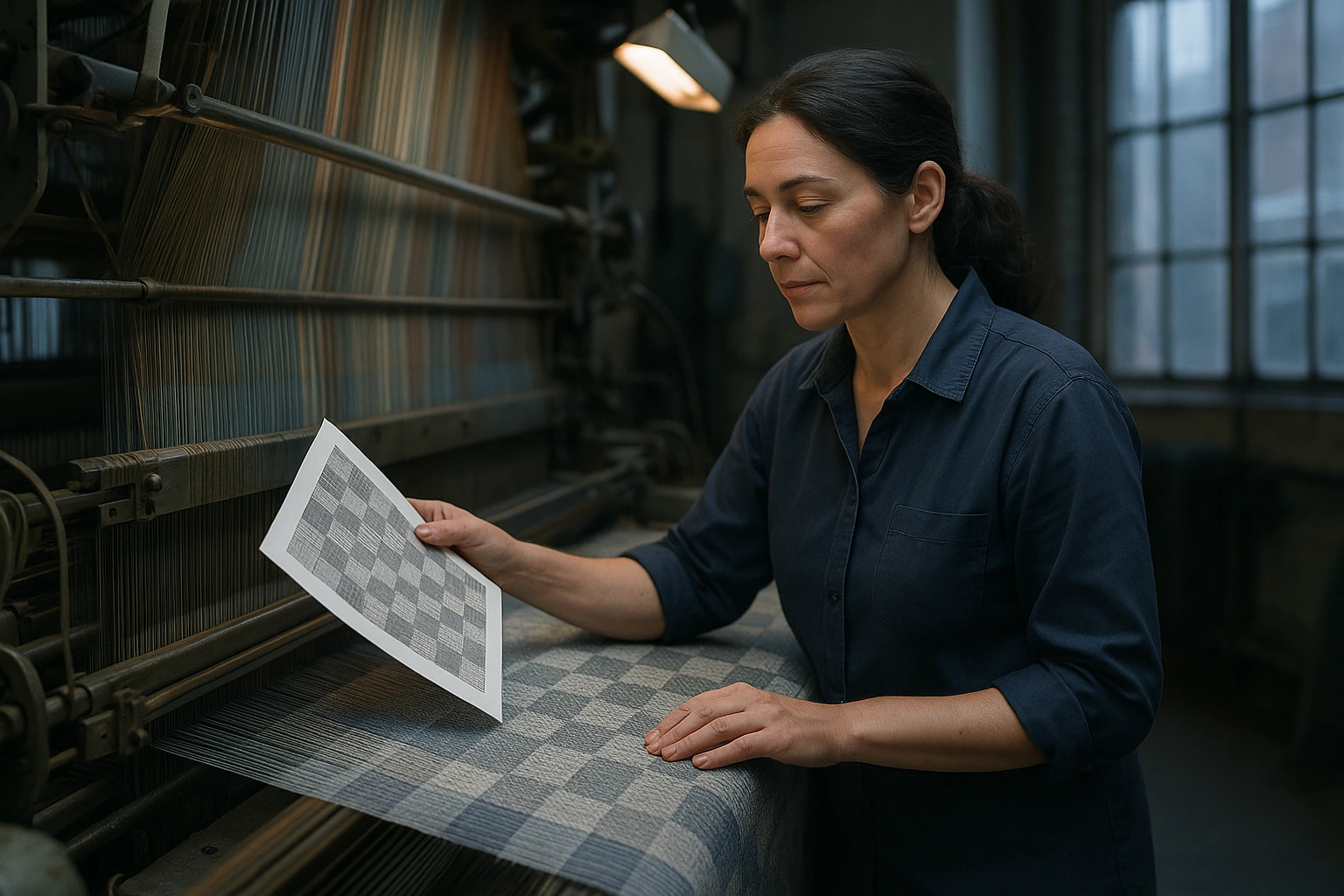
The Uncanny Valley is the odd one. In the Trend Arena the name covers technical elements shown rather than hidden: wires, connectors, coils, the machine’s insides used as ornament. The term comes from elsewhere. Masahiro Mori proposed bukimi no tani in 1970, describing how our response to a robot warms as it grows more humanlike, then drops into revulsion just short of human; Jasia Reichardt translated it as the uncanny valley in 1978. Mori’s valley is about near-likeness; the Frankfurt stream is about visible mechanism, which is close to the reverse. Nothing pretends to be human; the wires are the point. The borrowing is loose, and reads better as a mood than a citation.
- Jacquard weaving
- A loom mechanism controlling every warp thread individually from a stored pattern. Patented 1804.
- Generative design
- Software producing many variants of a pattern from a prompt, a rule set or a scan. The output is options; the judgement is the designer’s.
- Slub
- A thick, soft place in a spun yarn. Historically a fault, now often specified on purpose.
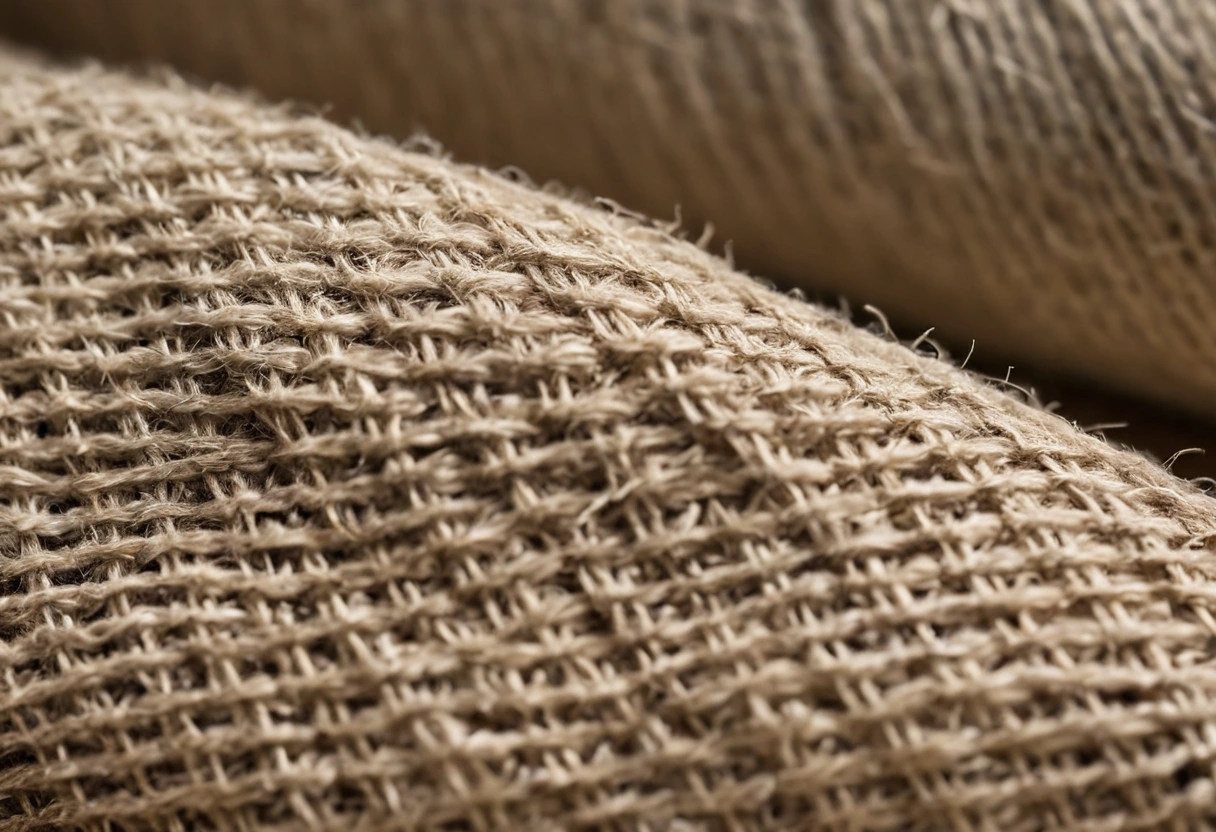
How to read a craft-and-code claim
The forecast will reach showrooms long before it reaches many looms, and it will arrive as copy. A few habits keep the story honest. For the next stage of the brief, see About Us.
- Ask where the machine actually was. “AI-designed” almost always means the pattern was explored in software and a person chose one. That is not the same as a cloth an AI wove.
- Separate the loom from the forecast. Jacquard capability is two centuries old, so a mill running patterns from files proves nothing.
- Check the finish, not the framing. Rub count and light fastness say more about a decade of use than any stream name.
The questions that separate a real process from a good caption are unglamorous. A mill or a showroom selling Italian woven upholstery and drapery fabrics should answer all of them without pausing.
- Was the pattern drawn, generated, or both, and who made the final selection?
- Is it woven or printed, and how will each age on this piece?
- Are the irregularities specified with a tolerance, or whatever the run produces?
- What is the repeat, and can you see it at the size it will be used?

Heimtextil 2026 will be remembered as the fair where the trade stopped arguing about whether AI belongs in cloth and started arguing about where to put it. The novelty in Frankfurt was not the technology. It was the decision to leave the join visible.



0 Comments